
The History of Fair Park's Lot #10
The 1960s-1970s Land Grab in Neighboring African American Community Encapsulates the History of African American Displacement in Dallas
Foreword
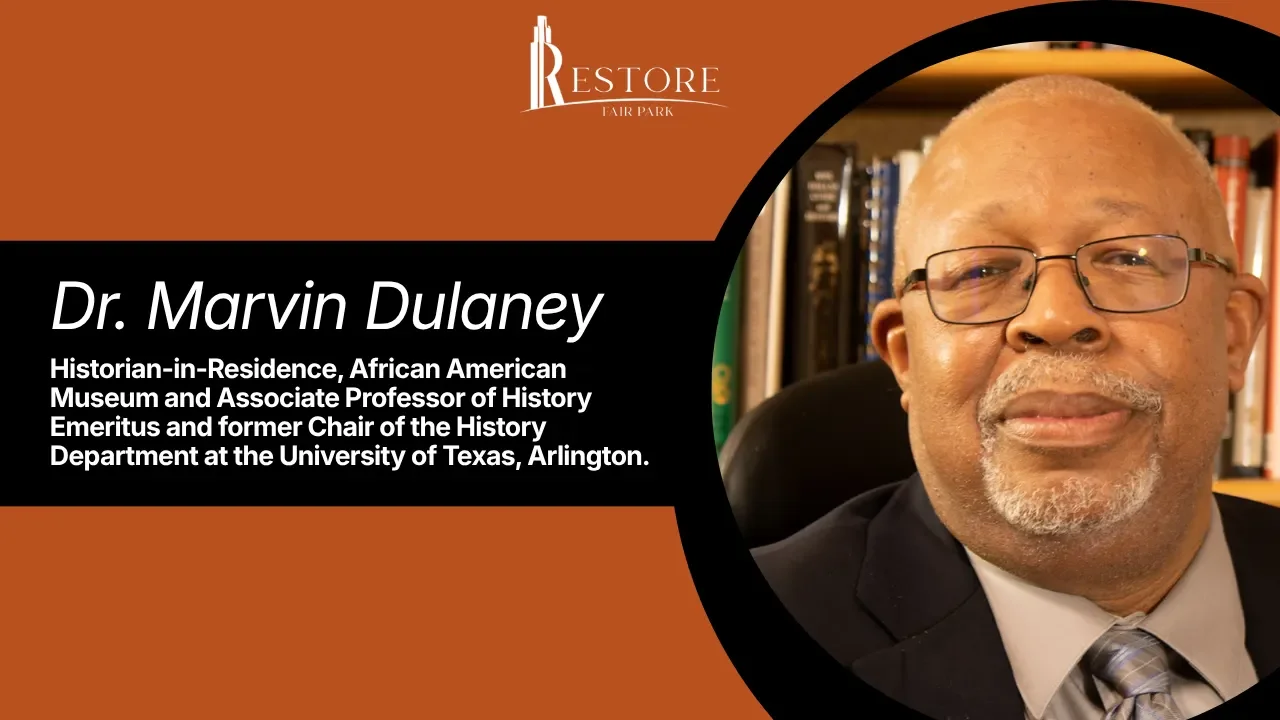
The following is excerpted from a report written by Historian and Scholar-in-Residence of the African American Museum Dr. Marvin Dulaney. Except for where noted within brackets and attributed to Restore Fair Park (RFP), all excerpts are from the report with the author’s permission.
[RFP: “African Americans, Fair Park and South Dallas” tells the story of Dallas’s African American community and examines how the city’s housing policies, along with patterns of migration and displacement, paved the way for Dallas to replace African American homes adjacent to Fair Park with thousands of parking spaces that expanded Fair Park’s campus.]
The 1969 Master Plan
In March 1969, State Fair of Texas President Robert B. Cullum, announced a Master Plan to expand Fair Park and create a 700-acre, first-class public park for the Fair, Cotton Bowl Classic, and Music Hall attendees. The proposal to expand Fair Park was an idea that had been brewing since 1959. The Master Plan was to expand the 190-acre core of Fair Park by acquiring 50 acres of land between Pennsylvania and Fitzhugh avenues, and Second Avenue and Gaisford Street. The plan was to create between 20,000 and 30,000 new parking spaces. The plan also included a new community park for residents of South Dallas.[1] Of course, the plan confronted a major problem: what would be done with the African-American homeowners who were to be displaced by the expansion of Fair Park?
The City of Dallas used eminent domain to claim the land needed to expand Fair Park. However, the homeowners in the area had nowhere to go, and the money offered by the city for their homes was insufficient to enable them to purchase new homes in other parts of the city. The city offered African American homeowners an average of $0.65 per square foot for their homes, while offering White homeowners as much as $4.17 per square foot. With the support of the Block Partnership, the residents resisted the city’s efforts to force them from their homes to expand parking for Fair Park. They obtained an injunction, filed a lawsuit, protested to the City Council and Mayor Erik Jonsson, and sought support from the leaders of the Southern Christian Leadership Conference (SCLC).[2]
Ten years passed before the city of Dallas completed the eviction of the homeowners and secured the land to expand Fair Park. The episode symbolized what African Americans have experienced throughout the nation’s history. That is, African Americans have lost land, been displaced by freeways and other developments, and been forced to move by gentrification and violence. There is a long history of the physical displacement of African Americans in the city of Dallas. The story of Fair Park is just one of them.
[RFP: Housing shortages followed by racial segregation ordinances and pressure campaigns by Whites to push out African Americans from neighborhoods led to the displacement of many African American families. The South Dallas and Mill City neighborhoods, close to Fair Park, were among the largest African American neighborhoods in the early 20th century. Those neighborhoods, as well as Wheately Place and Queen City, grew significantly in the 1930s.]
African Americans continued to move to South Dallas to attend Lincoln High School and to find decent housing that was unavailable to them in other areas of the city. Between 1940 and 1950, the African American population increased from 50,407 to 83,352, which exacerbated the housing crisis for them even more.[3] As a result, in 1950 and 1951, a group of resentful Whites, led by Claude Thomas Wright, carried out a second episode of bombings of the homes of African Americans in South Dallas. After ten bombings, an investigation by the FBI and the Texas Rangers led to the arrest of Wright. He was tried, but not convicted.[4]
African American presence in South Dallas led to more engagement with Fair Park. African Americans had always attended events and activities at Fair Park, specifically during the Texas State Fair. In the 1890s and the early twentieth century, educator N. W. Harllee served as the Superintendent of the Colored Department of the State Fair. His specific role and duties were to plan “Colored Day” at the State Fair. He planned the entertainment and the schedule of activities for the day. In 1899, for example, Colored Day at the State Fair included an awards ceremony for the students who had achieved academic honors in the city’s colored schools. In 1900, Harllee invited Tuskegee Institute president Booker T. Washington to the Colored Day celebration, who gave an address to a standing room only crowd at the Music Hall on October 8.[5]
African Americans also used Fair Park for activities such as Juneteenth celebrations. But their biggest celebration occurred in 1936 during the Texas Centennial Exposition when Antonio Maceo Smith and Maynard H. Jackson secured $100,000 to build the Hall of Negro Life.[6]
[RFP: A subsequent Substack newsletter will excerpt Dr. Dulaney’s report that tells the story of how the Hall of Negro Life came to be built and its significant impact on race relations in Dallas.]
Despite progressive decisions that developed as a result of African Americans coming together at the 1936 Texas Centennial in Fair Park, every October, African Americans were still restricted to one day to attend the State Fair of Texas on “Negro Achievement Day.” “Negro Achievement Day” was the only day that African Americans could access the Midway and other restricted concessions until 1961.
[RFP: In 1961, “Negro Achievement Day” was abolished and the State Fair was finally desegregated after four consecutive years of protest by the NAACP Youth Council and others.]
Even after the desegregation of the State Fair of Texas, however, there were other problems: crime and parking. The location of Fair Park in South Dallas allegedly exposed its White clientele to crime in the area when they attended the State Fair, the games of the Dallas Cowboys, and other events. The Dallas newspapers reported on the crimes experienced by White visitors to Fair Park constantly. After a Cowboys’ game in August 1967, some African-American youths attacked Whites leaving the Cotton Bowl, robbing and assaulting them. This incident led City Councilman Jesse Price to recommend that Fair Park needed a new stadium with improved parking protection. Dallas Cowboys owner, Clint Murchison, weighed in on the matter by observing that the new stadium actually needed “a moat with barbed wire around it, patrolled by police dogs.”[7]
The critics of Fair Park concluded that it was in the wrong part of the city, and the parking and crime problems had to be solved. In 1966, the State Fair of Texas hired Economic Research Associates (ERA) to develop a plan under the title, “A Redevelopment Program for the State Fair of Texas.” The ERA developed the Master Plan announced by Robert B. Cullom in 1969, cited on page one of this report. It was not a new plan. It replicated a 1956 purchase of 10.1 acres by the city that displaced over fifty African American homeowners along Pennsylvania Avenue, and a “Park and Open Space Plan of 1959” to take more land for parking.
African Americans whose homes were taken in 1969-1970, and their supporters, such as Peter Johnson of SCLC, fought the 1969 Master Plan to condemn and bulldoze their homes, and move them out of the way for Fair Park expansion. After fighting for four years, they lost in the courts. The story of the expansion of Fair Park has become an important part of the history of South Dallas, and it has overshadowed the community’s overall history.[8]
[RFP: Today, 10 acres of that site will become a community park built primarily for the benefit of South Dallas neighborhoods. Its design emphasizes community activities with amenities such as children’s playgrounds, a local marketplace and a community stage. It will also provide another much-needed green space for a 277-acre city park that is mostly buildings and concrete. The first promise of the community park was made by 1969 Master to expand Fair Park. It was expanded but without the “promised” community park. Once built, it will be completed almost 60 years later.]
End Notes
Bill Morgan, “Facelifting at the Fairgrounds,” Dallas Times Herald, November 29, 1966; Bob Sloan, “Fair Park Due Beauty Touch,” Dallas Times Herald, August 4, 1968; Jerry McCarty, “Fair Park Planning Bogs Down Again,” Dallas Times Herald, March 13, 1969; Carolyn Barta, “Cowboys Leaving, Parking Needed,” Dallas Morning News, July 31, 1969; and Collin Yarbrough, Paved A Way: Infrastructure, Policy and Racism in an American City (Coppell, TX: New Degree Press, 2022), 109-113.
“Houston Receives Fair Park Queries,” Dallas Times Herald, March 4, 1969; “Football Parking Expansion Rapped,” Dallas Times Herald, August 3, 1969; Jerry McCarty, “Now It’s All Up to Abernathy,” Dallas Times Herald, November 19, 1969; “Condemnation Halt Asked by Landowners,” Dallas Morning News, November 26, 1970; Yarbrough, Paved A Way, 113; and Jim Schutze, The Accommodation: The Politics of Race in An American City (Secaucus, NJ: Citadel Press, 1986), 163-168.
William H. Wilson, Hamilton Park: A Planned Black Community (Baltimore: John Hopkins University Press, 1998), 12.
Schutze, The Accommodation, 23-26; and Jim Schutze, “The Accommodation,” D Magazine, March 1987, https://www.dmagazine.com/publications/d-magazine/1987/march/the-accommodation/
“General Race News,” The Colored American, August 11, 1894; “Colored People’s Day,” Dallas Morning News, September 21, 1902; “A Long List of Awards,” Dallas Morning News,” October 24, 1899; “Colored Peoples Day,” Dallas Morning News, October 7, 1900; “Address by Booker T. Washington,” Dallas Morning News, October 9, 1900.
Juneteenth Celebration,” Dallas Morning News, June 15, 1919; A. Maceo Smith to Eugene Kinckle Jones, August 26, 1935, Folder 10, Correspondence, “Negro Participation,” Texas Centennial Collection, Box 212, Dallas Historical Society; and Paul L. Dunbar, “A. Maceo Smith and the Hall of Negro Life,” Legacies 23 (Fall 2011): 4-13
See the following examples: “Man Held As Suspect in 3 Rapes,” Dallas Morning News, March 6, 1960; “Three Youths Charged with Robbery,” Dallas Morning News, July 29, 1961; “Irving Girl Tells Police of Assault,” Dallas Morning News, April 15, 1962; “Garland Boy Stabbed by Negro Youth,” Dallas Morning News, August 31, 1962; “Expansion Urged for Stadium Area,” Dallas Times Herald, August 30, 1967; “Police Ready to Protect Grid Fans,” Dallas Times Herald, September 23, 1967; “Crime 0—58,000 See Grid Game, Depart without Incident,” Dallas Times Herald, September 30, 1967.
“Jury Trials Sought in Land Cases,” Dallas Morning News, June 26, 1970; and Crain, “The Fair Park Lie.” In addition to Crain’s articles in D Magazine and Jim Schutze’s The Accommodation, there are a plethora of articles and accounts of what happened in Fair Park and South Dallas in 1969-1979. For examples, see Peter Simek, “A Scathing Look at Fair Park’s History and Why Dallas Needs to Finally Fix the Park,” D Magazine, April 3, 2017; Jerome weeks, “Meet the Dallas Civil Rights Activist Whose Work in Fair Park Inspired the Play “Travisville,’” KERA Arts Access, December 15, 2022; and Bethany Erickson, “The Changing Face of Fair Park and South Dallas,” D Magazine, January 2, 2024.