
THE LOST ART OF FAIR PARK
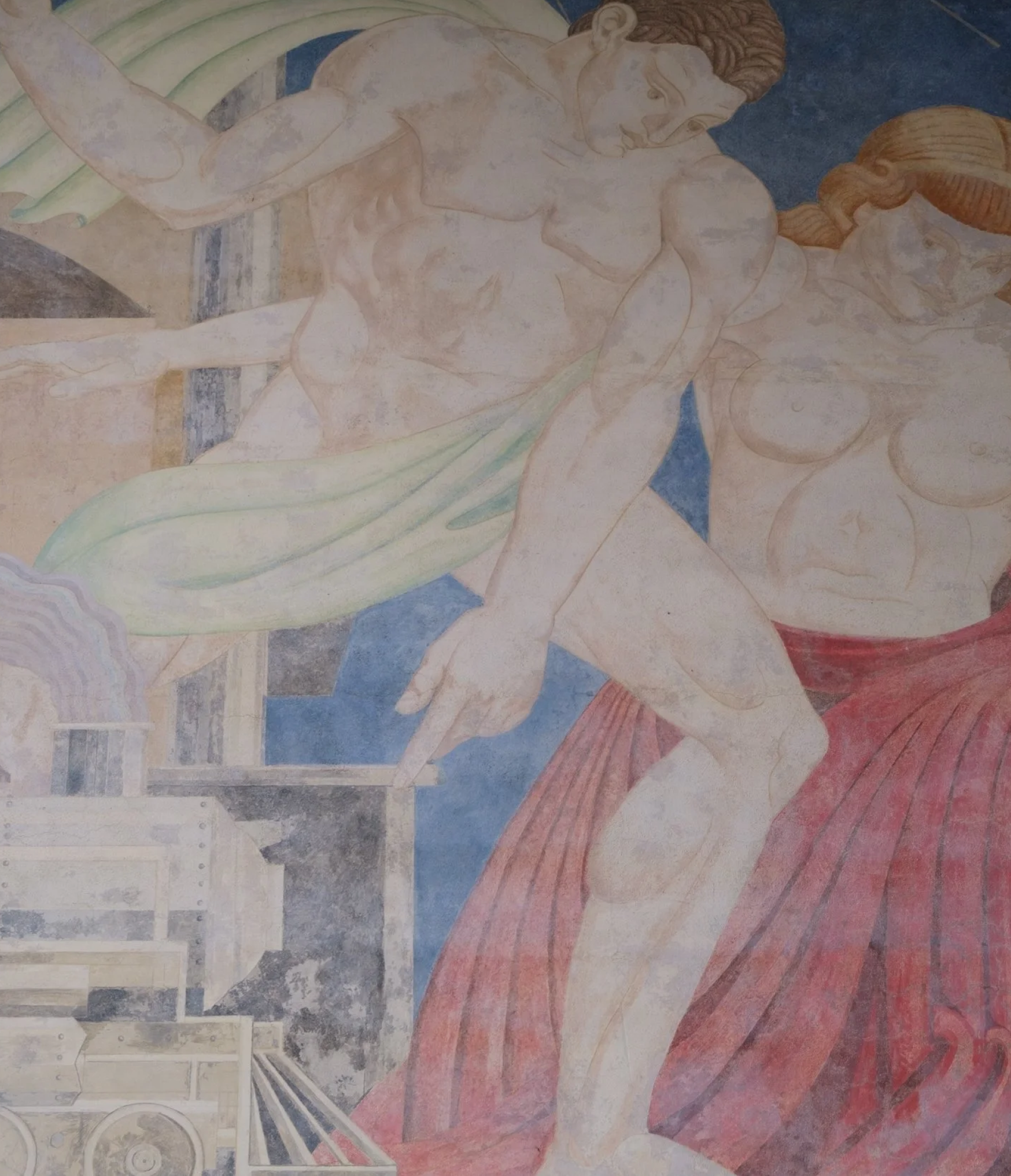
Faded external mural on Fair Park’s Transportation Building
By Abraham Moreno
Fair Park was transformed into one of the largest Art Deco collections in the United States for the 1936 Texas Centennial Exposition. Within this Art Deco paradise, nearly every major exhibition building was adorned by detailed and colorful murals, bas reliefs, cameos, and lunettes representing Texas, its history, and its contributions to the world.
Today, some of those works remain, but many have been lost to fires, demolitions, remodeling, and decades of overpainting. And much of the artwork and architecture that remains is fading and crumbling. Patchwork restorations occur, such as the uncovering and restoration of select murals in the 2000s. I have been able to confirm that 51 artworks that once existed have disappeared over time.
This leaves many to wonder: Why were these magnificent pieces of art destroyed or hidden out of the public’s sight?
We now understand that it was due to several factors. One of which was economics. It was simply cheaper for the city to maintain the permanent buildings, such as the Cotton Bowl and those found in the Agrarian and Civic Areas of the park, by painting over some of the art. A notable exception is the Hall of State (formerly the Texas State Building), which remains filled with original and maintained artworks.
Another factor is that the more durable statues and bas-reliefs incorporated into buildings were destroyed when buildings intended to be temporary were demolished following the 1936 Centennial Exposition and the subsequent Greater Texas & Pan-American Exposition in 1937. Some of these buildings included the Hall of Varied Industries, Communications, and Electricity, the Petroleum Building, the Management Building, and the Hall of Negro Life.
Another factor was the racial and broad-minded undertones present in much of the art. Murals, statues, and reliefs showcased nudity. Murals and reliefs depicted people of color and people with darker skin tones as empowered.
Many artworks also featured European and other traits, as much of the artwork was created by Italian, French, Norwegian, and African American artists, who, during a time of heightened nationalism, were already facing considerable hostility from local artists and nationalist groups, who accused them of taking jobs away from "real Americans.”
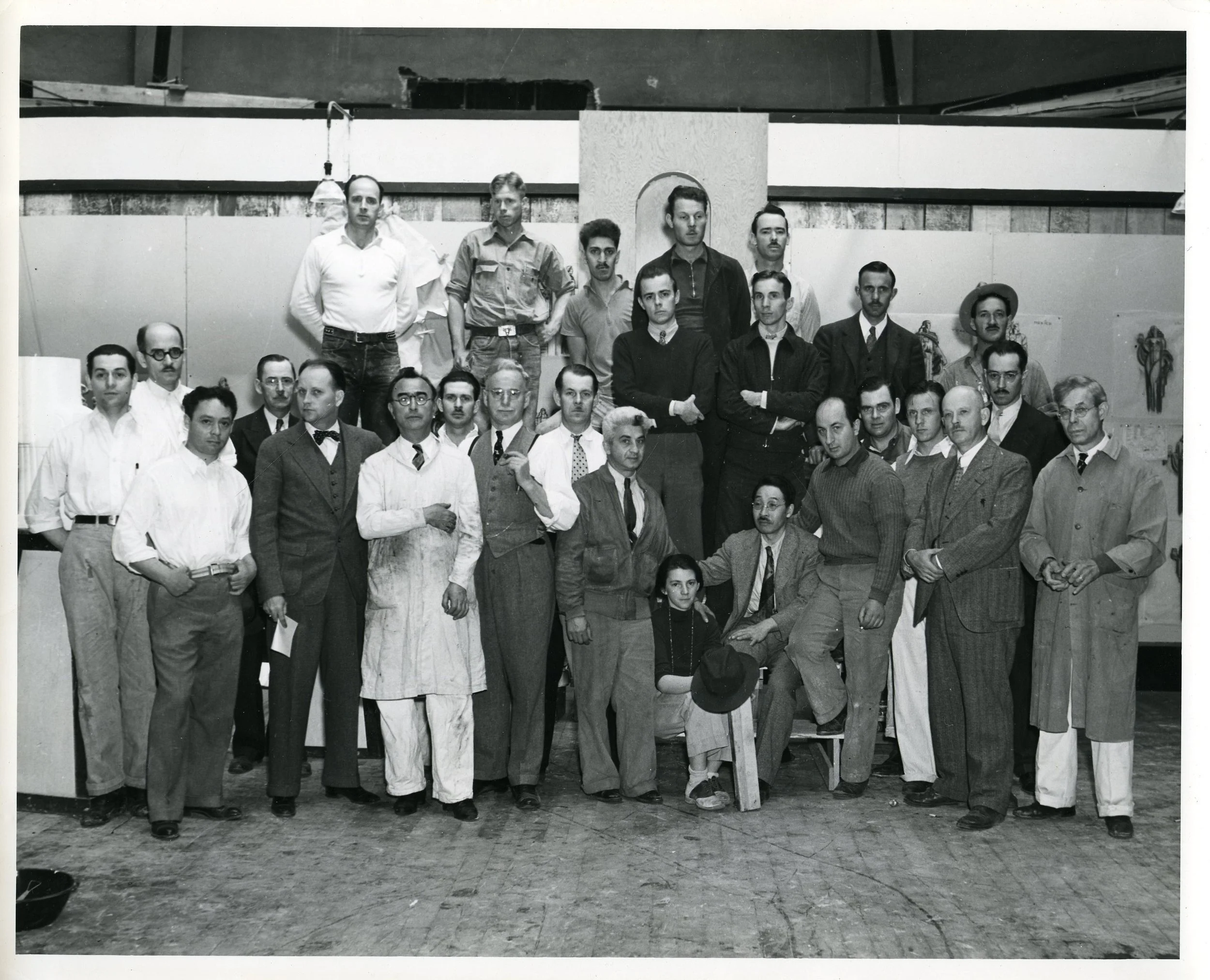
Group of Texas Centennial Exposition artists who created murals, friezes, sculpture and other art works.
Source: Dallas Historical Society, Texas Centennial Exposition Collection
These attitudes were fueled in part by the Great Depression, American isolationism, the "Mexican Repatriation" program, and the rise of hate groups such as the American German Bund and the Ku Klux Klan. In the 1920s and 1930s, Dallas had one of the highest proportions of Klan membership of any U.S. city, according to the Texas State Historical Society.
This discrimination can be seen in the construction and eventual demolition of the Hall of Negro Life, according to the Legacies Journal by the Dallas Historical Society. Although the Texas state legislature agreed with the idea of having an African American exhibit, what “undermined” the issue was an election to fill a vacancy in the Texas House of Representatives. When the seat opened, and nearly 70 candidates expressed interest, leaders of Dallas's black community decided to support a black candidate. White politicians from around the state made it clear to Dallas's civic leaders, both black and white, that if a black candidate won the election, the legislature would deny Dallas's bid to host the Centennial Exposition and money to build an African American hall.
The Exposition bid went forward, and local civil rights leaders like Antonio Maceo Smith worked to secure funding from the federal government to build the African American exhibition hall, The Hall of Negro Life.
When visitors came to the 14,000 square-foot exhibit hall, they saw a large seal depicting a figure breaking free from chains sculpted by Raoul Josset, and the lobby displayed four murals by notable painter and major figure in the Harlem Renaissance, Aaron Douglas, named “Aspiration”, “Into Bondage”, “Negro’s Gift to America”, and one nicknamed “Estevanico”. Unfortunately, the Texas Centennial Commission chose to demolish the Hall of Negro Life in the spring of 1937 after failed attempts by African American community leaders to keep it intact had failed. Along with the demolition of the exhibit hall, the last two of the four mural panels mentioned were lost or destroyed. The surviving two were saved and are currently kept in the DeYoung Fine Arts Museum of San Francisco and the Smithsonian Corcoran Gallery of Art.
Some people may question why we should invest in restoring or recreating lost art at Fair Park. I believe the explanation from Towards the Contemporary Conservation of Cultural Heritages, published in Heritage by MDPI, says it best:
“Conserving cultural heritages includes not only preserving them by restoration but also establishing their value so that they can be reused and play a role in contemporary society… conserving cultural heritages has expanded from restoring heritage alone to recognizing its importance to human identity, social cohesion, and transmission of culture.”
This is especially true for New Deal–era art, which holds a special place in Western art history. Today, the messages in these artworks remain important, with the rise of political divide across the country, AI-generated art, and reduced public access to the arts. Restoring and recreating these artworks can remind people of the value of art and unity in society, and most importantly, inspire future architects, musicians, writers, and artists.
I am one of those future artists inspired by the art of Fair Park. Like many Dallas natives, I grew up attending the annual State Fair of Texas, which takes place in Fair Park. While the food and the sounds of the midway caught most of my attention, it was the year-round access to Fair Park’s art and architecture that inspired me to study architecture and art history and to advocate for this beautiful park that has impacted on the lives of many Dallasites.
Long live Fair Park!
Dear readers,
Please meet the essay author, Abraham Moreno who has been inspired by the art, architecture and history of Fair Park. He gives me hope that Dallas youth can appreciate, understand and want to preserve this historical site. Abraham is a college freshman, and he and I first started talking about Fair Park when he was still in high school. Keep an eye on this young civic leader. I’m pretty sure you’ll hear his name again in the future. Read more about him below.
Myra Moore
Abraham Moreno is a college freshman currently studying Architecture and Art History. He serves as a first-year representative on the Student Advisory Board for the Architectural Studies and Art History Department at Connecticut College in New London, Connecticut.
Originally from Monterrey, Nuevo León, Mexico, he has worked and advocated for the implementation of laws and plans that help promote the construction of affordable housing, transit, green spaces, and the development of walkable, diverse, and sustainable communities. In addition, he has collaborated and volunteered with countless organizations such as Dallas Neighbors for Housing, The City of Dallas Youth Commission, The Dallas Housing Coalition, The Science Place Foundation, Rayo Planning, Greater Dallas Planning Council, Latino Outdoors, Better Block, City of Dallas Planning and Development Department, and The National Wildlife Federation.
As a result of his work, he has been featured in articles and interviews by various Dallas-based outlets, including D Magazine, The Oak Cliff Advocate, Dallas Observer, and Telemundo 39, a Spanish-language television station owned by NBCUniversal. One day, he aspires to pursue a career in Architecture, Historic Preservation, and Urban Planning & Design, following in the footsteps of eminent figures such as Frida Escobedo, George Dahl, Jan Gehl, Gordon Bunshaft, and Luis Barragan.
Bibliography
L. Dunbar, Paul. “A. Maceo Smith and the Hall of Negro Life.” Unt.edu. Dallas Historical Society, 2011. https://texashistory.unt.edu/ark:/67531/metapth204537/m1/
Li, Lanxin, and Yue Tang. “Towards the Contemporary Conservation of Cultural Heritages: An Overview of Their Conservation History.” Heritage 7, no. 1 (December 31, 2023): 175–92. https://doi.org/10.3390/heritage7010009.
Ulaby, Neda, and NPR. “Art of the New Deal: How Artists Helped Redefine America during the Depression.” KPBS Public Media.
KPBS, May 25, 2020. https://www.kpbs.org/news/2020/05/25/art-of-the-new-deal-how-artists-helped-redefine?