The 1936 Texas Centennial Exposition, created to celebrate the 100th anniversary of Texas’ independence from Mexico, featured one of the most ambitious and collaboratively built public art programs in the United States during the interwar period.
Under the direction of architect George Leighton Dahl, the Exposition’s buildings were conceived not merely as exhibition halls but as living museums where architecture, sculpture, color, and mural paintings combined to convey modernity, unity, and prosperity. The mural program, executed by nationally and internationally trained artists including but not limited to Julian Ellsworth Garnsey, Pierre Bourdelle, Carlo Ciampaglia, Thomas Stell Jr., Eugene Gilboe, Aaron Douglas, and others, played a central role in defining the Exposition’s visual identity. Their works ranged from fifty-foot allegorical mural paintings to animal lunettes and large-scale reliefs.
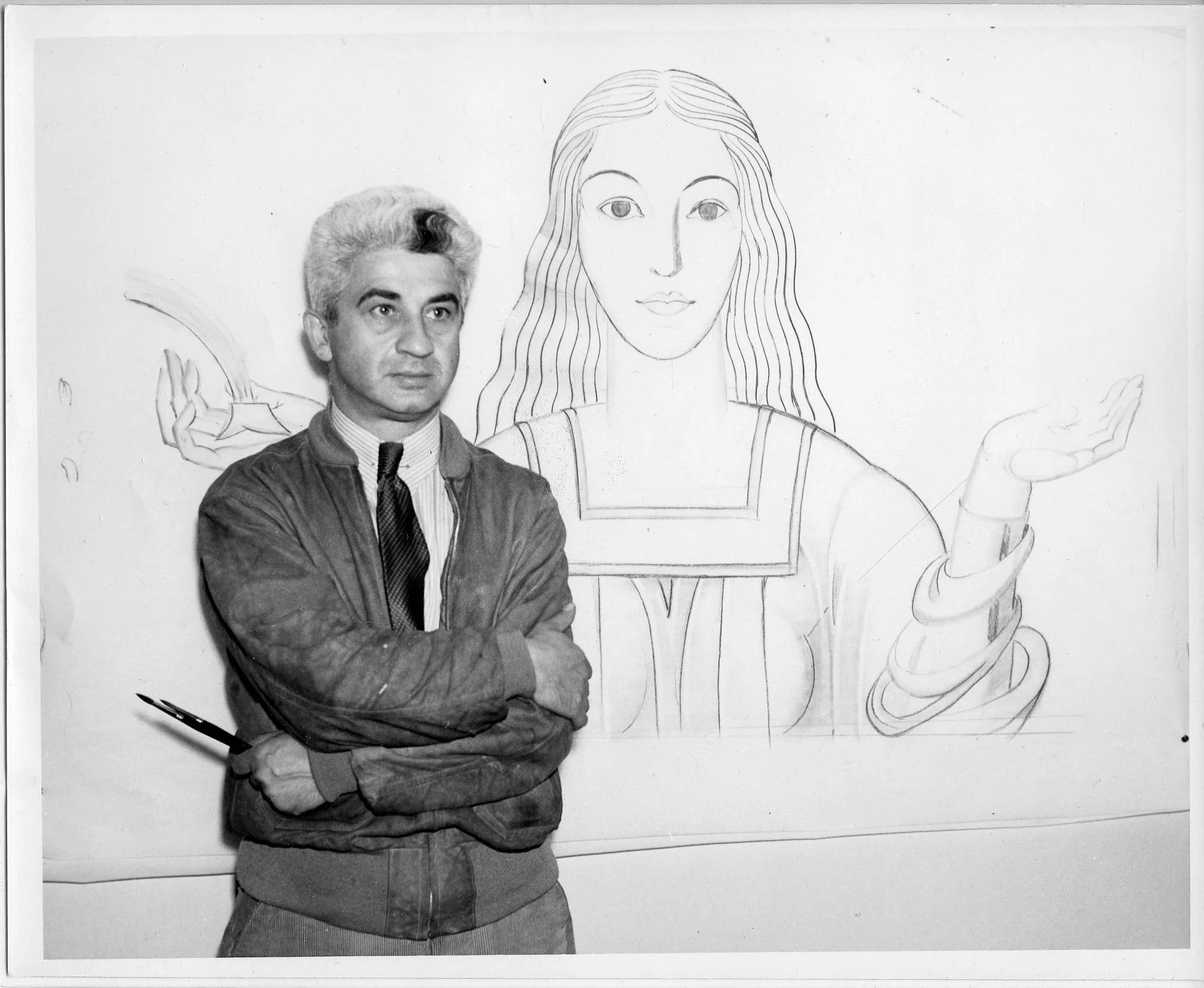
Image of Centennial Exposition artist Carlo Ciampaglia in front of a sketch. Ciampaglia was the murals program director and directed a number of muralists tasked with executing his vision. Source: The Dallas Historical Society Texas Centennial Exposition Collection.
The hallmark of these artworks is the remarkable level of collaboration among the artists and architects to accomplish the herculean task under extreme time pressure. The exposition was designed and built in a little more than 14 months, which included about 30 new structures as well as renovation of select existing structures. A feat difficult to imagine being accomplished today.
A number of these structures were intricate and large buildings such as the State of Texas Building (now Hall of State), The Federal Building (now the Tower Building), the Dallas Natural History Museum and the Dallas Museum of Fine Arts. All included multiple artworks.
A crucial body of evidence comes from the surviving personal letters of Hector E. Serbaroli, an Italian-born Hollywood scenic artist recruited to Dallas in 1936. These letters, likely the only firsthand correspondence from a Fair Park muralist, offer an intimate view of the project’s internal workings. They describe Dahl’s urgent need for trained muralists and the intense pressure under which the artists labored.
Serbaroli recounts arriving in Dallas after a two-day train journey, meeting an international team of muralists, and being immediately assigned to translate the mural program director and muralist, Carlo Ciampaglia’s conceptual sketches into a fully realized fresco. This included the Fecundity and Wheat Harvesters murals in the Food and Fiber and Embarcadero Buildings.
According to his letters, Serbaroli developed the composition, symbolism, color program, anatomy, and overall aesthetic, effectively building the mural from its conceptual outline into its monumental, finished form. His descriptions of extreme heat, long workdays, and the challenge of training inexperienced local assistants further illuminate the collaborative difficulties of a massive, fast-paced mural program.
The collaboration among individual artists was supported by a hierarchy of architects and designers passing down designs to individual (and groups of) artists to execute the prescribed visions. Thus, the authorship of many of these works has been misunderstood for decades.
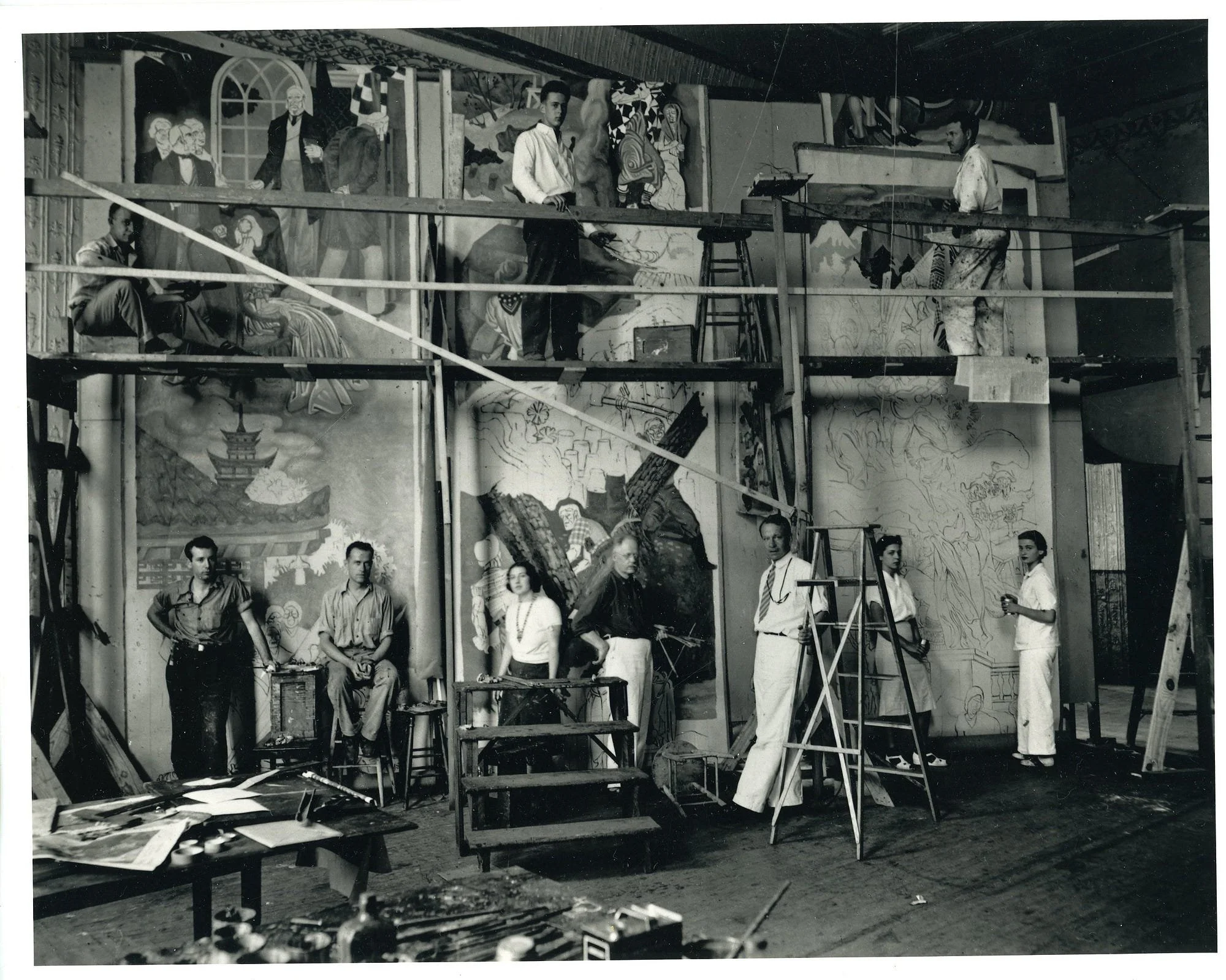
Image of Texas Centennial Exposition artists working on a canvas mural in the workroom of Eugene Savage's design studio in New York. Source: The Dallas Historical Society Texas Centennial Exposition Collection.
When several murals were uncovered and restored in 2000 (see The Lost Art of Fair Park - Restore Fair Park Dallas), public-facing materials such as brochures, interpretive signage, and city websites often credited Ciampaglia as the painter of nearly all the restored murals. While Ciampaglia did create two murals at the Food and Fiber Building, this narrative has led to the false impression that he was solely responsible for both the paintings and for creating many of the murals found throughout Fair Park.
Serbaroli’s letters confirm that the mural program at Fair Park was not the work of a single artist but rather a coordinated effort involving many individuals, each bringing their own unique training, cultural backgrounds, and technical expertise.
When examining archival correspondence, period journalism, municipal documents, and contemporary materials, it becomes evident that Fair Park’s murals represent a remarkable instance of artistic collaboration rather than individual authorship.
Documenting this is crucial for understanding the true artistic legacy of the 1936 Exposition. By reconstructing the mural program using historical evidence, I aim to restore recognition to the many artists who contributed to Fair Park’s visual identity and to preserve the cultural memory of one of America’s most significant Art Deco achievements.
Author bio:
Abraham Moreno is currently studying Architecture and Art History at Connecticut College in New London, Connecticut. There he serves as a representative on the Student Advisory Board for the Architectural Studies and Art History Department. Originally from Nuevo León, Mexico, he has worked and advocated for the implementation of laws and plans that help promote the construction of affordable housing, transit, green spaces, and the development of walkable, diverse, and sustainable communities. In addition, he has collaborated and volunteered with countless organizations such as Dallas Neighbors for Housing, The City of Dallas Youth Commission, The Dallas Housing Coalition, The Science Place Foundation, Rayo Planning, Greater Dallas Planning Council, Latino Outdoors, Better Block, City of Dallas Planning and Development Department, and The National Wildlife Federation.
Bibliography:
Ulaby, Neda, and NPR. “Art of the New Deal: How Artists Helped Redefine America during the Depression.” KPBS Public Media. KPBS, May 25, 2020. https://www.kpbs.org/news/2020/05/25/art-of-the-new-deal-how-artists-helped-redefine?.
Dallas Historical Society. Legacies: A History Journal for Dallas and North Central Texas, Volume 23, Number 2, Fall 2011, periodical, 2011; Dallas, Texas. (https://texashistory.unt.edu/ark:/67531/metapth204537/), University of North Texas Libraries, The Portal to Texas History,
Townsend Cummins, “Light. Allie Victoria Tennant and the Visual Arts in Dallas”. Texas A&M University Press, 2015.