FOREWORD
The following is excerpted from “African Americans, Fair Park and South Dallas: A Report” written by Historian and Scholar-in-Residence of the African American Museum Dr. Marvin Dulaney. Except for where noted within brackets and attributed to Restore Fair Park (RFP), all excerpts are from the report with the author’s permission.
--------------------------------------------------------------------------------------
[RFP: The creation of the Hall of Negro Life for the 1936 Texas Centennial Exhibition was more than just a groundbreaking exhibition that featured contributions of African Americans to U.S. history in the heart of Texas. Its short life sparked a powerful Texas civil rights legacy that endures today.
Dr. Dulaney recounts how Dallas African American leaders fought to secure the Hall of Negro Life despite opposition from the state legislature. He also shows how the Hall introduced White visitors to the breadth of African-American contributions to American life and served as a catalyst of the Texas Civil Rights movement.]
Before the 1936 Centennial African Americans had always attended events and activities at Fair Park, specifically during the Texas State Fair and for Juneteenth celebrations.
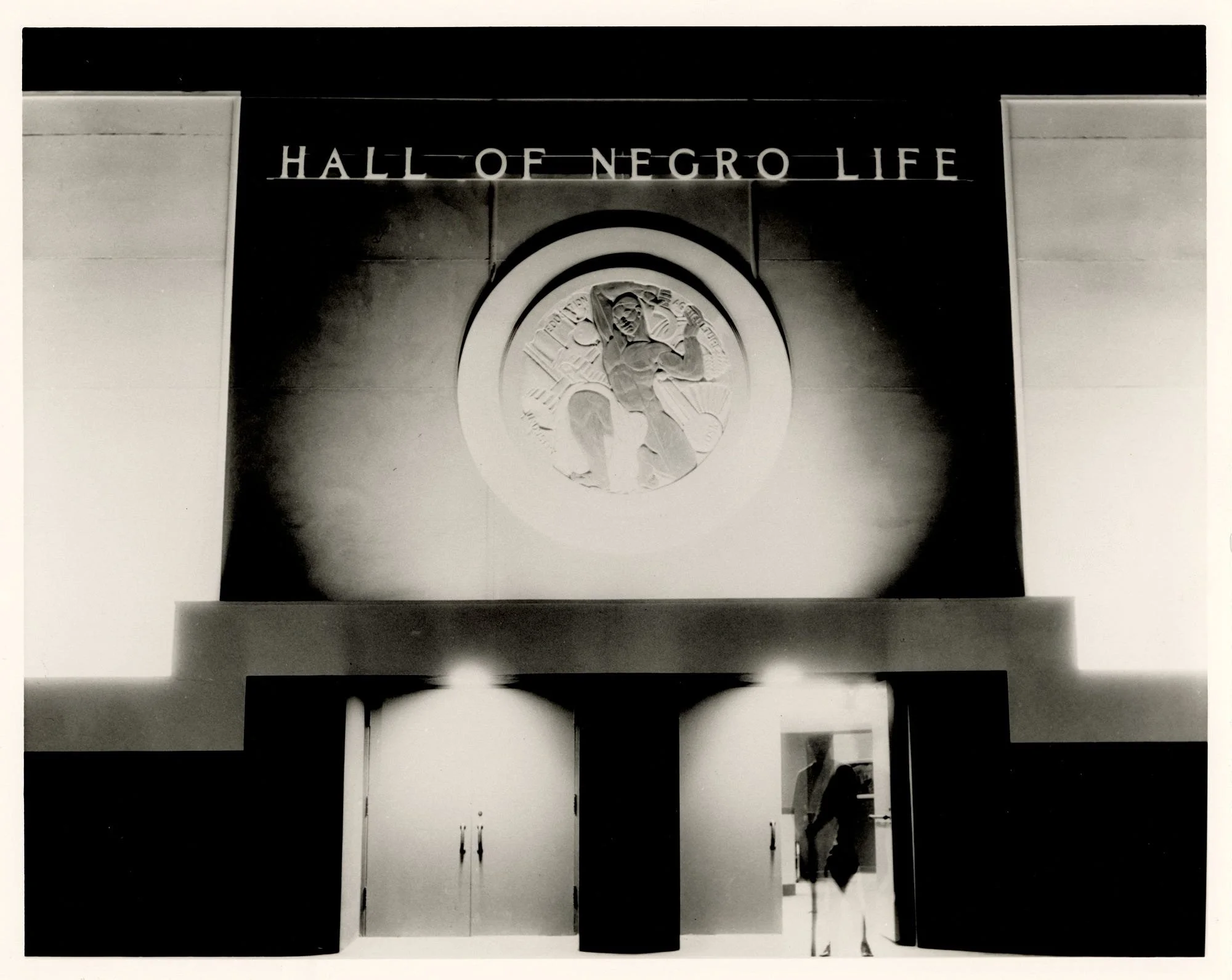
Source: The Dallas Historical Society Texas Centennial Exposition Collection.
But their biggest celebration occurred in 1936 during the Texas Centennial Exposition when Antonio Maceo Smith and Maynard H. Jackson secured $100,000 to build the Hall of Negro Life. This was a major achievement at the time because African Americans had participated and had a major presence in only three other national and state celebrations: the 1893 Chicago World’s Fair, the 1901-1902 South Carolina Inter-State and West Indian Exposition, and the 1907 Jamestown Ter-Centennial Exposition.
Smith and Jackson actually lost the state funding for the “Negro Building” when they refused to stop Attorney Ammon S. Wells from running for a seat in the state legislature in 1935. The state legislature made funding for the “Negro Building” contingent upon their stopping Wells from running for the seat. They refused and lost the funding. Fortunately, they were able to secure funding from the federal government and the Roosevelt administration to build the Hall of Negro Life and to install a first-class exhibition that covered various aspects of African American life, such as art, education, agriculture, scientific innovation, business, religion, and, of course, the contributions of African Americans to American history.
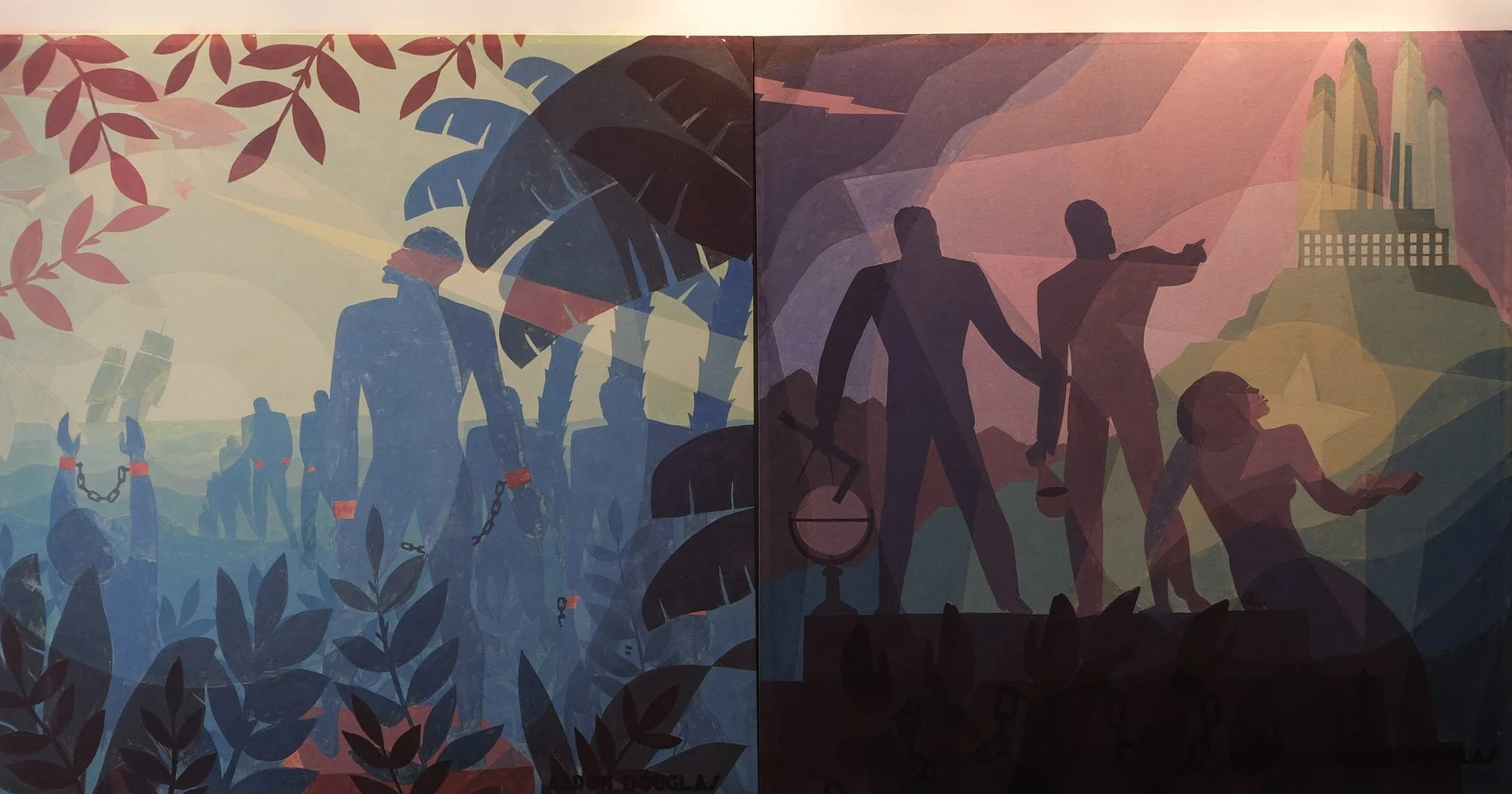
Reproductions of Aaron Douglas painting displayed in the Hall of Negro Life.
[RFP: Among the most notable art works within the Hall of Negro Life were four murals created by painter and major figure in the Harlem Renaissance, Aaron Douglas. Two of those murals were destroyed when the building was torn down and the remaining two are kept in the De Young Fine Arts Museum in San Francisco and the Smithsonian Corcoran Gallery of Art. A reproduction of both of those paintings can be found at Dallas’ African American Museum in the Solarium.]
The Hall of Negro Life had a very significant impact on race relations in Dallas. In addition to exposing many whites to the contributions of African Americans to American life, it challenged the strict, racist conventions that ruled race relations in the city. Given that the Hall of Negro Life was a building for, about, and run by African Americans, they resented the fact that the building had segregated bathrooms. After the Hall opened on June 19, 1936, protests by African Americans forced the general manager to remove the “colored” signs on the bathrooms and open them to all visitors without any racial discrimination. Similarly, all people who visited the Hall had to mingle and observe its exhibitions without any consideration or special treatment for White people.
The Centennial’s “Special Days” also made a positive statement on race relations. Actors Orson Welles and John Houseman directed a production of Macbeth with an “all-Negro cast” from the Harlem Unit of the WPA Theatre Project. Visitors to the Centennial were entertained by actors Rex Ingram and Bill “Bojangles” Robinson and musicians Cab Calloway and Duke Ellington. Another highlight was an interracial track meet at the Cotton Bowl, which featured African-American Olympians Ralph Metcalf and Eddie Tolan.
Before the Hall of Negro Life closed and the city tore it down in March 1937, the meeting of African Americans from other cities and areas of the state left a long-lasting legacy. While they were in Dallas for the Centennial, they organized three statewide organizations: the Texas Negro Peace Officers Association, the Texas Negro Chamber of Commerce, and, most importantly, the Texas State Conference of Branches of the National Association for the Advancement of Colored People (NAACP). The organization of the latter organization, the Texas State Conference of the NAACP, galvanized the civil rights movement in the state of Texas and led to the outlawing of the state’s white primary that restricted the right of African Americans to vote in the Democratic Party’s primary (Smith v. Allwright, 1944); the equalization of the salaries of African-American teachers with those of White teachers in Dallas (Page v. City of Dallas Board of Education, 1943); and the desegregation of the University of Texas Law School (Sweatt v. Painter, 1950).
Despite these progressive decisions that developed as a result of African Americans coming together at the 1936 Texas Centennial in Fair Park, every October, African Americans were still restricted to one day to attend the State Fair of Texas on “Negro Achievement Day.” “Negro Achievement Day” was the only day that African Americans could access the Midway and other restricted concessions until 1961.
[RFP: One can draw a direct line between the desegregation of the State Fair of Texas in 1961, and the formation of the Texas NAACP branch by African American leaders visiting the Texas Centennial and the Hall of Negro Life. After four years of protest by the Dallas NAACP Youth Council, advised by Juanita Craft, the State Fair of Texas ended “Negro Achievement Day.”
If the federal government hadn’t provided funds when the Texas Legislature pulled funding for the Hall of Negro Life, it would probably not have been built. But it was built, and although the city tore down the building in 1937, the seeds of civil-rights progress had been planted by those inspired by the ideals held inside that exhibit hall.]
NOTES
1 Juneteenth Celebration,” Dallas Morning News, June 15, 1919; A. Maceo Smith to Eugene Kinckle Jones, August 26, 1935, Folder 10, Correspondence, “Negro Participation,” Texas Centennial Collection, Box 212, Dallas Historical Society; and Paul L. Dunbar, “A. Maceo Smith and the Hall of Negro Life,” Legacies 23 (Fall 2011): 4-13
2 Although Frederick Douglass and Ida B. Wells protested the lack of African-American exhibitions and the stereotypical African village exhibition, there was significant African-American participation at the Chicago World’s Fair. See Christopher Reed, “All the World Is Here!:” The Black Presence in White City (Bloomington: Indiana University Press, 2000). African Americans also participated substantially in the South Carolina Inter-State and West Indian Exposition in Charleston, South Carolina. See Bruce Harvey, “South Carolina Inter-State and West Indian Exposition,” South Carolina Encyclopedia, Walter Edgar, Editor (Columbia: University of South Carolina Press, 2006), 898-899. The participation of African Americans in the 1907 Jamestown Ter-Centennial was exceptional. W. Sidney Pittman served as the architect for the “Negro Building,” and Meta Warrick Fuller designed ten dioramas for the Negro exhibition. See W. Fitzhugh Brundage, “Meta Warrick’s 1907 Tableau and (Re)Presenting African American Historical Memory,” The Journal of American History 89 (March 2003): 1368-1400.
3 Robert S. LaForte, “Hughes, Sarah Tilghman,” Handbook of Texas Online, accessed December 08, 2023, https://www.tshaonline.org/handbook/entries/hughes-sarah-tilghman; “Negro Has Chance in Texas Election,” New York Times, February 24, 1935; “Wells Runs for Legislature,” Dallas Express, March 2, 1935; “A Courageous Negro,” Pittsburgh Courier, March 9, 1935; Dunbar, “Smith and the Hall of Negro Life,” 6; and Jesse O. Thomas, Negro Participation in the Texas Centennial Exposition (Boston: The Christopher House Publishing, 1938), 130-143.
4 See “Race Jim Crowed at Texas Centennial,” “Protest Signs on Lavatories at Texas Fair,” and “Smashes Jim Crow at Texas Fair; Defender Wins Fair Jim Crow Fight,” Chicago Defender, June 27, 1936, July 4, 1936; and July 11, 1936, respectively; and Thomas, 85.
5 Alonzo J. Aden, “An Educational Tour Through the Hall of Negro Life,” Southern Workman 65 (November 1936): 331-341; and “83,000 Visit Negro Building,” Dallas Express, July 25, 1936.
6 “Dallas Welcomes MACBETH,” Dallas Express, August 10, 1936; and Thomas, 56-57, 96, and 149.
7 “Commission Says the Hall of Negro Life Will Not Re-Open,” Atlanta Daily World, February 16, 1937; “Order Dismantling of Race Exhibit at Texas Centennial,” Chicago Defender, February 29, 1937; Thomas, 89-90; Michael Gillette, “The Rise of the NAACP in Texas,” Southwestern Historical Quarterly 81 (April 1978): 393-414; and W. Marvin Dulaney, “Whatever Happened to the Civil Rights Movement in Dallas, Texas?” in W. Marvin Dulaney and Kathleen Underwood, Editors, Essays on the American Civil Rights Movement (College Station: Texas A & M University Press, 1993), 72-79.